
Fayette Projected Versus Actual Release
A projected date is a planning field calculated from the sentence and information then available. An actual release is an accomplished event recorded by the agency that ended custody or transferred the person. Those facts can be days or months apart. A date shown while a person remains incarcerated can change through jail-time credit, earned credit, discipline, a sentence amendment, judicial release, parole action, another hold, or a data correction.
Pretrial detainees usually have no sentence-based release date. Their exit may depend on bond, a court order, dismissal, or later sentencing. A locally sentenced Fayette County Jail inmate has a court-imposed term and credited time, while an ODRC prisoner has state sentence fields and may have parole or indefinite-sentence issues. The source must match the custody type.
Find Fayette Projected Release Dates
For an Ohio prison case, begin with the ODRC Offender Search. The form accepts name, offender number, county of commitment, residential county, ZIP, status, and parole-hearing month. County of commitment means the sentencing source, not the person's current home. Use Fayette when the court committed the person, then open the detail and compare the docket, offender number, date of birth, offense, judge, and committing county.
A county-only jail term takes a different path. Read the journalized sentence in Common Pleas for a felony or Municipal Court for a misdemeanor. Note the term and jail-time credit. Then ask Fayette County Jail for its existing calculation or the jail-register entry. ODRC earned-credit rules should not be imported into a local jail sentence without legal authority. For the full identity and custody-source sequence, use the Fayette County released inmate lookup.
- Determine whether the person is awaiting trial, serving a Fayette jail term, serving an ODRC term, or held for another agency.
- For ODRC custody, search by name and offender number, open the detail, and read status with the combined expected or eligibility field.
- For a local term, obtain the court's final sentence and its jail-time-credit figure from the proper Fayette court.
- Ask the jail for the current calculation or release entry. If another hold appears, follow the receiving agency.
- After the date passes, recheck actual status and obtain the discharge, release, supervision-start, or transfer record.
Note: The Fayette live jail roster is current-custody only; disappearance supports neither the exact release time nor release to the community.
Fayette ODRC Release Date Fields
Ohio's live detail uses the exact label “Expected Release Date/Parole Eligibility Date.” That wording combines concepts that ODRC definitions discuss separately. PRD means projected release date. POA means parole on or after, the earliest date release on APA supervision may occur. A parole-eligibility date may lead to review and a decision; it is not a promise that the person leaves on that day.
Read the combined field next to status. An `INCARCERATED` result with a future date supports present state custody and a planning or eligibility date. It does not support completed release. `APA SUPERVISION` with an actual Supervision Start Date is stronger evidence that prison confinement ended and state supervision began. A Released result or judicial-release detail has still another meaning. After any expected date, check the status, supervision start, and release or parole detail.
The ODRC definitions and release-date screen shows how Ohio describes these fields.
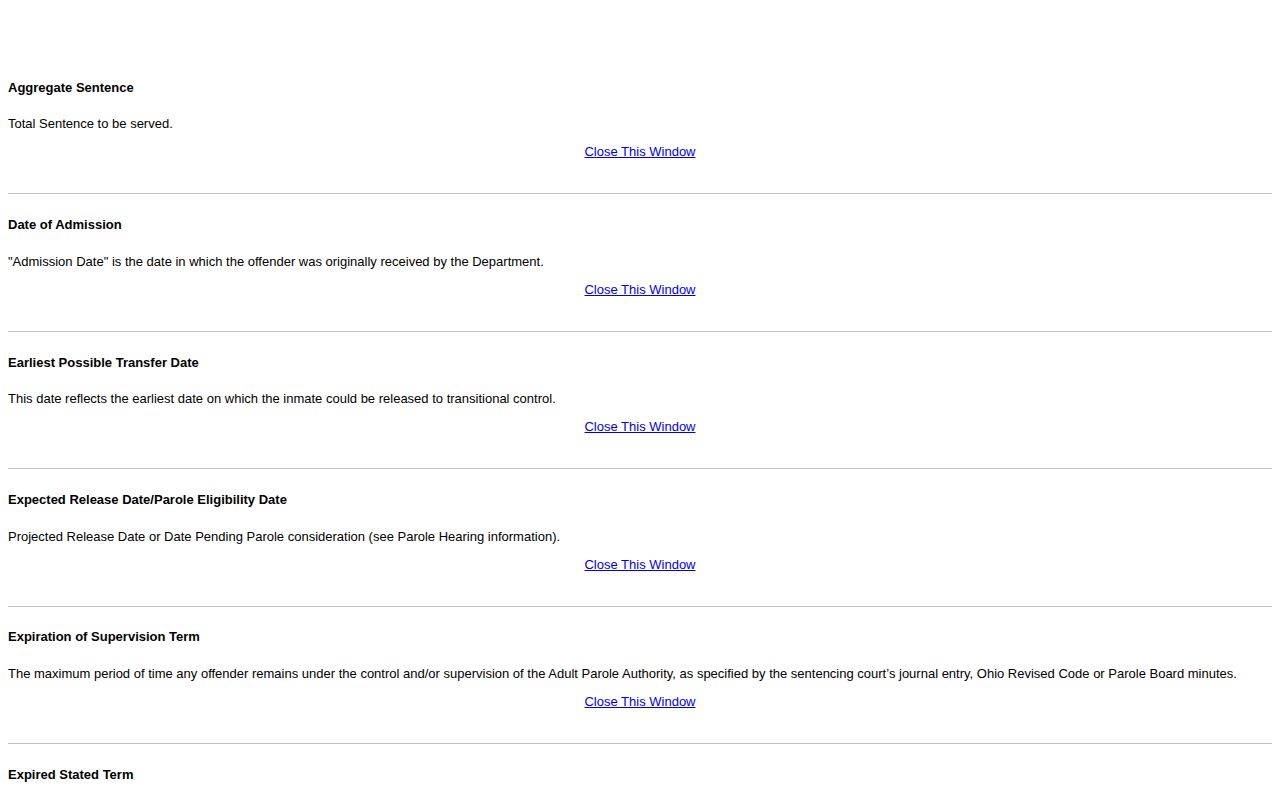
The interface language is why the visible date should be quoted as labeled and never shortened to “confirmed release date.”
Ohio Credit for Fayette Release Dates
Ohio Revised Code 2967.194 governs qualifying productive-participation credit for eligible time beginning April 4, 2024. It permits provisional credit of one or five days per completed month for qualifying activity, potentially plus additional credit for a second qualifying activity. Listed completions can yield a specified completion credit. Under the relevant provisions, participation and completion credit is ordinarily capped at 15 percent of the stated prison term.
The 15 percent ceiling explains the common “85 percent” shorthand for an eligible term under that mechanism. It is not a rule that every Ohio prisoner serves exactly 85 percent. Mandatory and nonreducible time does not qualify, and the statute excludes several serious offense and sentence categories. Credit remains provisional. Misconduct can lead to denial or withdrawal, and administrative review finalizes it. Qualifying confinement before April 4, 2024 is addressed by the older transition provision in ORC 2967.193.
Jail-time credit is different. ORC 2967.191 reduces a prison term for qualifying time already spent confined because of the offense, such as pretrial custody in lieu of bail or time awaiting transport. That is past time served, not future program credit. The ODRC detail may show the credit used in its sentence computation.
Fayette Indefinite Sentence Dates
ORC 2929.14 governs many felony prison terms, including Reagan Tokes indefinite minimum and maximum terms for qualifying first- and second-degree felonies committed on or after March 22, 2019. A combined expected-release or parole-eligibility field in such a record may reflect the sentence framework. It cannot be read as a guaranteed exit without the underlying sentence and current status.
Parole-eligible cases also require sentence-specific review. The ODRC search accepts a next-hearing month and individual details may show the next review month and latest hearing type or result. Granted, denied, continued, and rescinded outcomes are not interchangeable. A grant may set a future date and conditions. A denial can lead to another projected date. The official decision and later status are the controlling records.
Why Fayette Release Dates Change
A computed date is only as stable as its inputs. Some changes move the date forward. Others can create an earlier lawful path. Still others leave the sentence date intact but prevent release to the community. The table separates those effects so a hold is not mistaken for added sentence time and an eligibility event is not mistaken for discharge.
| Factor | Possible effect | Record to verify |
|---|---|---|
| Jail-time credit | Counts qualifying confinement already served | Journalized sentence and ODRC computation |
| Earned credit | May reduce an eligible state term after review | ODRC sentence detail and applicable statute |
| Misconduct | Can cause provisional credit denial or withdrawal | ODRC administrative record and updated date |
| Court order | May modify the sentence or authorize judicial release | Final court entry and ODRC status |
| Parole action | May grant, deny, defer, or rescind a planned release | Parole result, official decision, and later status |
| Detainer or hold | Can send the person to another custodian instead of the community | Release or transfer entry and receiving agency |
| Data update | Corrects a field without itself causing release | Current detail and originating sentence |
Concurrent and consecutive terms can also change the calculation. Concurrent terms run at the same time, while consecutive terms run one after another. The court's journalized sentence controls which applies. ODRC can display aggregate or net sentence information, but its own definitions caution that sentencing data may be incomplete. When the detail and judgment appear to conflict, obtain the certified judgment and ask ODRC or the jail to identify the inputs used.
Fayette Jail Release Calculations
For a Fayette County Jail sentence, the starting record is the court's journalized entry. The Common Pleas search covers felony cases, while Washington Court House Municipal Court handles countywide misdemeanor and traffic cases. The sentence states the imposed term, while the court and jail records identify qualifying jail-time credit. Use the Fayette sheriff records route to ask how the jail system applied those inputs rather than using a state-prison formula.
The actual jail-register discharge entry is the end-point record. It can state the date and manner of discharge. Ohio jail rules also call for release-document and identity checks, return of property, and transfer details when another agency receives the person. If the expected date passes but the person remains listed, call the jail. Another sentence, hold, or processing event may control. Do not declare the roster wrong from arithmetic alone.
A bond case should not be forced into this sentence calculation. Bond can authorize release before final disposition once its conditions are met, and court processing can precede physical discharge. A transfer to ODRC is also not the end of all custody. The Fayette jail record should name the receiving authority, after which the state offender record becomes the right source for later expected, parole, or supervision dates.
Confirm Fayette Actual Release Dates
Prospective notice and final proof serve different roles. Ohio VINE can send an alert when a participating county or state feed reports a release, transfer, or other custody event. Registration works best while the person remains in custody. A VINE event can lag and may describe only the reporting agency's stage, so direct confirmation remains necessary.
For a Fayette jail case, call the jail and request the register or release entry. For an ODRC case, recheck status, Supervision Start Date, and release or parole detail. For another-agency or federal holds, follow the receiving system. The Fayette County VINELink inmate search explains how to register and distinguish county events from ODRC events.
For a past event, ask for the existing release document rather than a fresh forecast. A narrowly worded request can seek the date, manner of discharge, releasing authority, and receiving agency if a transfer occurred. Ohio public-records law requires access to responsive public records subject to exemptions and redaction, but it does not require an office to create a new calculation that it does not keep.
Keep the court date, projected date, and operational discharge time as separate facts. That simple timeline prevents a sentence entry from being reported as the moment the jail door opened.
Note: Record the source update time and your search time separately; a court order, jail discharge, and alert can post at different times.